


Syllabus: GS2/IR
Context
- The Chief of Defence Staff (CDS) mentioned that India believed the 1954 Panchsheel Agreement effectively addressed the northern boundary question, even though China viewed it differently.
Panchsheel Agreement
- In 1954, India recognised Tibet as part of China, and both countries signed the Panchsheel Agreement.
- The Panchsheel Agreement stated the five principles as:
- Mutual respect for each other’s territorial integrity and sovereignty.
- Mutual non-aggression.
- Mutual non-interference in each other’s internal affairs.
- Equality and cooperation for mutual benefit.
- Peaceful co-existence.
- It was designed to promote trade and friendly relations, forming the basis of the bilateral ties.
- With this, India assumed that it had settled its northern border.
- In 2025 the Chinese President underscored that Panchsheel must be cherished and promoted by the two countries.
- It came as India and China reset their ties and PM Modi visited China after seven years.
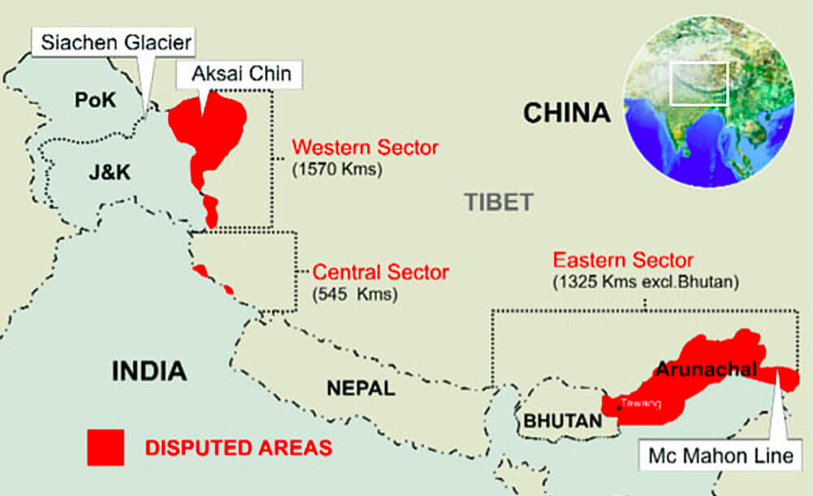
The India-China Borders
- India considers the Line of Actual Control (LAC) to be 3,488 km long, while the Chinese consider it to be only around 2,000 km.
- It is divided into three sectors: the eastern sector which spans Arunachal Pradesh and Sikkim, the middle sector in Uttarakhand and Himachal Pradesh, and the western sector in Ladakh.
- Western Sector or Aksai Chin Sector: The region is claimed by the Chinese government post-1962 war as an autonomous part of the Xinjiang region which was originally a part of the Indian state of Jammu and Kashmir.
- Middle Sector: It is the less disputed section of the Indo-China border but the recent Doklam standoff and Nathu La Pass trading issues have brought distress at all levels.
- Eastern Sector or Arunachal Pradesh:McMahon Line had differentiated India and China in this sector but in the 1962 war the People’s Liberation Army covered 9000 sq. km. area.
- The announcement of a unilateral ceasefire made them step back on the international borderline.
- However, China has been claiming that area as their own and recently they have started to claim the whole of Arunachal Pradesh as their own.
India-China Relations
- 2025 marks the 75 Years of India-China diplomatic ties.
- Historical Tensions:
- Strained since the 1962 Sino-Indian war, deepened by recent clashes and mistrust.
- In 2020, the clash between both armies in Galwan Valley further strained the relationship.
- India restricted Chinese investments, banned Chinese apps, and halted flights to China.
- Trade Relations: In 2025, bilateral trade between China and India reached a record high of $155.6 billion, registering a year-on-year growth of over 12 per cent. Despite tensions, economic ties continue to grow.
- Ongoing Mechanisms: Despite tensions, mechanisms like the Special Representatives (SR) and Working Mechanism for Consultation and Coordination (WMCC) have been in place to address the boundary issue.
- Recent Developments:
- 2024 Disengagement: India and China announced successful disengagement in eastern Ladakh.
- October 2024 Meeting: PM Modi and President Xi Jinping emphasized “mutual trust, mutual respect, and mutual sensitivity.”
- In 2025 both Nations resumed direct flights and the Indian PM also visited China for the SCO summit.
Areas of Concern
- Ongoing Border Tensions:
- The unresolved border dispute spans over 2,000 miles, marked by frequent clashes that have strained the relationship.
- Military Standoff and Infrastructure Build-up: Large-scale troop deployment, rapid infrastructure construction, and militarisation along the LAC by both sides have increased the risk of escalation.
- China–Pakistan Nexus: Deepening strategic cooperation between China and Pakistan, especially under the China–Pakistan Economic Corridor (part of the Belt and Road Initiative) which passes through the Indian territory of Pakistan-occupied Kashmir.
- Trade Imbalance: India faces a significant trade deficit with China, with heavy dependence on Chinese imports in sectors such as electronics, APIs (pharmaceuticals), telecom equipment, and solar panels.
- China’s growing presence in the Indian Ocean Region: Sri Lanka: China’s presence at Hambantota Port and investments in an oil refinery raise concerns in India.
- Nepal: China’s investments in infrastructure (e.g., Pokhara airport) challenge India’s strategic position.
- Bangladesh: China’s growing influence, including loan agreements, threatens India’s regional influence.
- Myanmar: China’s deepening ties with Myanmar, including the China-Myanmar Economic Corridor, strengthen its presence in India’s backyard.
India’s Efforts to Address these concerns
- Strengthening Military Preparedness: Enhanced troop deployment and infrastructure along the LAC, induction of advanced weapons systems, and improved surveillance in border areas like Ladakh and Arunachal Pradesh.
- Strategic Partnerships in Indo-Pacific: Active participation in the Quadrilateral Security Dialogue (Quad) and deeper defence cooperation with the US, Japan, Australia, and France.
- Technology & Cyber Security Safeguards: Exclusion of high-risk vendors in telecom infrastructure and promotion of trusted, indigenous digital ecosystems.
- Maritime Security: India has prioritized maritime security, expanding its naval capabilities and strengthening defense ties with the U.S. and Japan.
- Joining Infrastructure Projects: India joined infrastructure projects such as the Global Infrastructure Facility and India-Middle East-Europe Economic Corridor to strengthen its economic expansion.
- Trade Relations: India seeks to reduce reliance on Chinese goods, especially in electronics and renewable energy.
Way Ahead
- India must maintain constant surveillance of border areas and the Indian Ocean Region, and closely monitor geopolitical and technological developments that may impact national security.
- The path forward lies in combining firmness on sovereignty and territorial integrity with calibrated diplomacy and strategic autonomy.
Source: TH
Previous article
News In Short 13-02-2026
Next article
Rural Transformation Through Decentralization
